
Building muscle takes more than spending hours lifting weights at the gym. If you want bigger muscles, improved strength, and a stronger physique, choosing the right exercises is an important part of your training routine. However, with so many exercises available, knowing which ones actually support muscle growth can be confusing.
So, what exercises are best for muscle growth? Some of the most effective options include squats, deadlifts, bench presses, rows, shoulder presses, pull-ups, and lunges. These movements target major muscle groups and allow you to gradually increase resistance as your strength improves.
The key is combining compound exercises with isolation movements, following a consistent workout schedule, and giving your muscles enough time to recover.
Whether you’re a beginner or an experienced gym-goer, this guide covers the best muscle-building exercises, how to perform them, and how to structure your workouts for better results.
Muscle growth, also known as hypertrophy, happens when your muscles adapt to the demands placed on them through resistance training.
When you lift weights or perform challenging bodyweight exercises, your muscles experience mechanical tension and other training-related stimuli that contribute to muscle development.
An effective muscle-building exercise should allow you to:
Challenge your muscles with appropriate resistance.
Perform controlled repetitions using proper technique.
Gradually increase weight or repetitions over time.
Train your muscles through a comfortable, effective range of motion.
Perform enough challenging sets to stimulate muscle growth.
Both compound and isolation exercises have a place in an effective muscle-building program.
Compound exercises involve multiple joints and muscle groups during a movement. They’re useful for developing overall strength and training several muscles efficiently.
Examples include squats, deadlifts, bench presses, and pull-ups.
Isolation exercises focus primarily on one muscle group or joint movement. They’re useful for adding targeted training volume to specific muscles.
Examples include bicep curls, triceps extensions, lateral raises, and leg extensions.
Combining both exercise types can help you develop a balanced physique and address individual muscle groups.
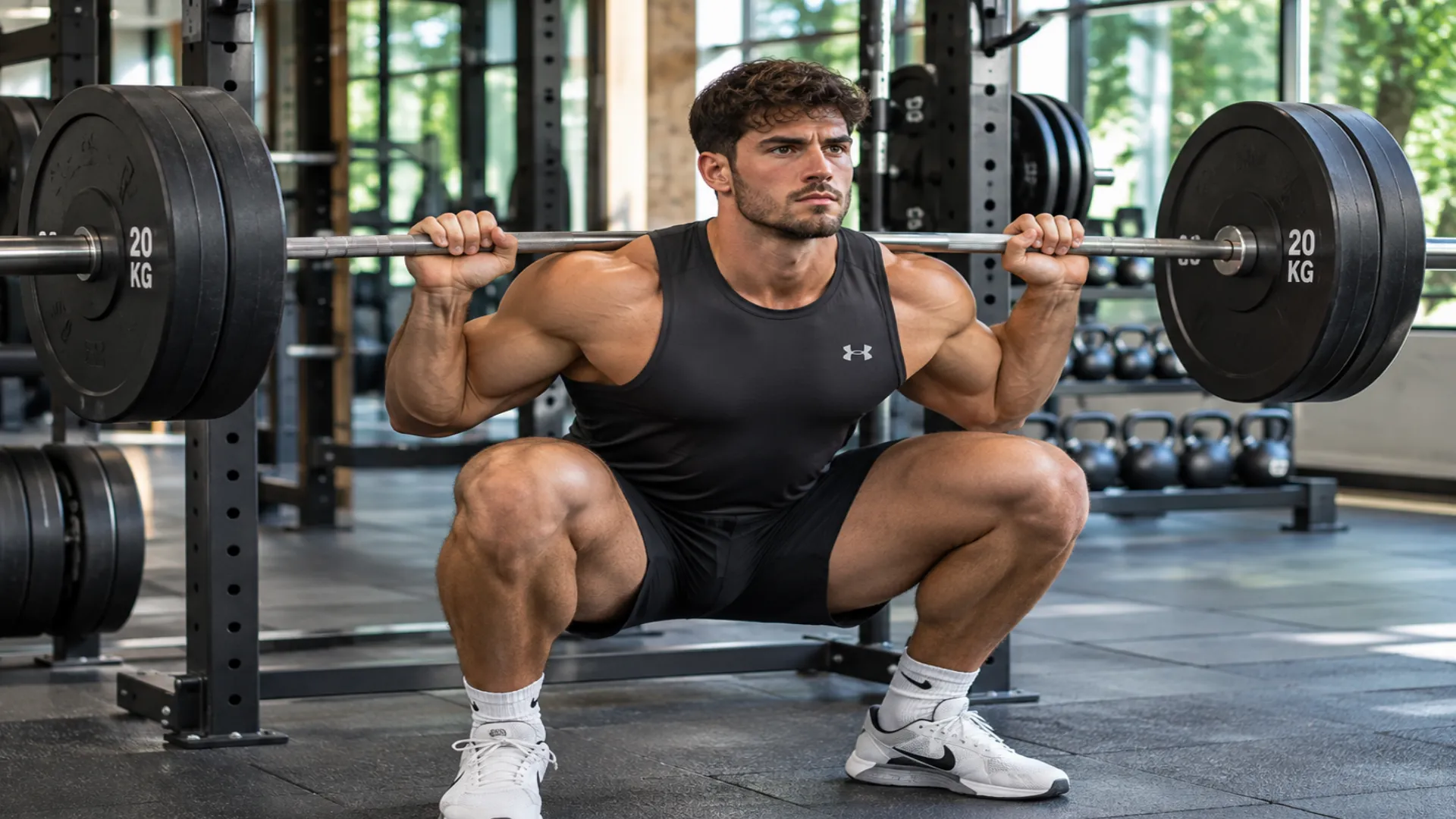
If your goal is to build muscle, prioritize exercises that train your major muscle groups and allow you to progress over time.
Here are ten effective exercises to consider adding to your workout routine.
Barbell squats are one of the most effective exercises for developing lower-body strength and muscle size. They primarily target the quadriceps and glutes while also involving the hamstrings and core muscles.
Because squats involve several major muscle groups, they’re a valuable exercise in many muscle-building programs.
How to perform barbell squats:
Stand with your feet approximately shoulder-width apart.
Position the barbell securely across your upper back.
Keep your chest lifted and your core engaged.
Bend your knees and hips to lower your body.
Descend to a comfortable depth while maintaining control.
Push through your feet to return to the starting position.
Recommended sets and reps: 3–4 sets of 8–12 repetitions.
If you’re a beginner, start with bodyweight squats or goblet squats before progressing to heavier barbell variations.
Deadlifts are compound exercises that target several muscles throughout your body, particularly the glutes, hamstrings, and back.
They help develop overall strength while teaching you to lift objects from the floor using controlled hip and leg movements.
How to perform deadlifts:
Stand with your feet approximately hip-width apart.
Position the barbell over the middle of your feet.
Bend your hips and knees to grip the bar.
Keep your spine in a stable, neutral position.
Push through your feet and extend your hips and knees to stand.
Lower the bar under control.
Recommended sets and reps: 3 sets of 6–10 repetitions.
Deadlifts require good technique. Start with manageable resistance and consider working with a trainer if you’re unfamiliar with the movement.
The bench press is a popular upper-body exercise that primarily targets the pectoral muscles, with assistance from the shoulders and triceps.
It’s particularly useful for developing chest strength and size.
How to perform the bench press:
Lie flat on a bench with your feet planted on the floor.
Grip the bar slightly wider than shoulder-width.
Unrack the bar and position it above your chest.
Lower it slowly toward your mid-chest.
Press the bar upward until your arms are extended without aggressively locking your elbows.
Recommended sets and reps: 3–4 sets of 8–12 repetitions.
If you’re new to the exercise, dumbbell chest presses or machine chest presses can provide a suitable alternative.
Pull-ups are an excellent bodyweight exercise for developing your upper back, latissimus dorsi, and biceps.
They also challenge your grip strength and upper-body control.
How to perform pull-ups:
Grip a pull-up bar with your palms facing away from you.
Start from a controlled hanging position.
Engage your back and abdominal muscles.
Pull yourself upward until your chin reaches the bar.
Lower yourself slowly to the starting position.
Recommended sets and reps: 3 sets of 6–10 repetitions.
If you can’t perform a full pull-up yet, use an assisted pull-up machine or resistance band. Lat pulldowns are another effective option.
Rows are important for developing a stronger, thicker back. The bent-over row primarily targets the upper back and lat muscles while also engaging the biceps and other supporting muscles.
Including rowing movements in your routine can also help balance pushing exercises such as bench presses.
How to perform bent-over rows:
Stand with your feet hip-width apart.
Hold a barbell with your hands slightly wider than shoulder-width.
Push your hips backward and lean forward while maintaining a stable spine.
Pull the bar toward your lower abdomen.
Squeeze your shoulder blades together.
Lower the bar slowly.
Recommended sets and reps: 3 sets of 8–12 repetitions.
Focus on controlled movements rather than using momentum to lift the weight.
The overhead shoulder press targets the deltoid muscles, particularly the front and middle portions of your shoulders. It also involves the triceps and core.
You can perform this exercise with dumbbells, a barbell, or a shoulder press machine.
How to perform a dumbbell shoulder press:
Sit or stand with a dumbbell in each hand.
Position the dumbbells near shoulder height.
Keep your core engaged and your back stable.
Press both dumbbells overhead.
Lower them slowly to the starting position.
Recommended sets and reps: 3 sets of 8–12 repetitions.
Choose a weight that allows you to maintain proper posture without excessive arching of your lower back.
If you want to develop stronger and more defined arms, bicep curls are a useful isolation exercise.
They primarily target the biceps brachii, helping develop the muscles at the front of your upper arms.
How to perform dumbbell bicep curls:
Stand upright while holding a dumbbell in each hand.
Keep your elbows close to your sides.
Curl the dumbbells toward your shoulders.
Squeeze your biceps at the top.
Slowly lower the weights.
Recommended sets and reps: 2–3 sets of 10–15 repetitions.
Avoid swinging your body to lift the weights. Controlled repetitions help keep the focus on your biceps.
The triceps make up a significant portion of your upper-arm muscle mass. Training them directly can help develop bigger, stronger arms.
Cable triceps pushdowns are a practical isolation exercise that targets the triceps.
How to perform triceps pushdowns:
Attach a straight bar or rope to a cable machine.
Stand facing the machine and grip the attachment.
Keep your elbows close to your sides.
Push the attachment downward until your arms are extended.
Slowly return to the starting position.
Recommended sets and reps: 2–3 sets of 10–15 repetitions.
Keep your upper arms relatively stationary throughout the exercise to focus the movement on your triceps.
Lunges are a unilateral lower-body exercise, meaning they train one leg at a time.
They help develop the quadriceps and glutes while challenging balance, coordination, and stability.
How to perform walking lunges:
Stand upright with your feet hip-width apart.
Take a controlled step forward.
Bend both knees to lower your body.
Keep your front knee aligned with your foot.
Push through your front foot to stand.
Repeat with the opposite leg.
Recommended sets and reps: 2–3 sets of 10–12 repetitions per leg.
You can begin with bodyweight lunges and gradually introduce dumbbells as your strength improves.
Hip thrusts are particularly effective for targeting the gluteal muscles. They’re a useful addition to lower-body routines for anyone looking to develop stronger and more muscular glutes.
How to perform hip thrusts:
Sit on the floor with your upper back against a stable bench.
Position a padded barbell across your hips.
Bend your knees and place your feet flat on the floor.
Drive through your feet and lift your hips.
Squeeze your glutes at the top.
Lower your hips slowly.
Recommended sets and reps: 3 sets of 8–12 repetitions.
Start with bodyweight hip thrusts before adding resistance. Avoid excessively arching your lower back at the top of the movement.
Knowing which exercises to perform is only part of building muscle. You also need a workout schedule that allows you to train consistently and recover between sessions.
A three-day full-body routine is a practical starting point for beginners and people with busy schedules.
Here is an example:
| Exercise | Sets | Reps |
|---|---|---|
| Barbell Squats | 3 | 8–10 |
| Bench Press | 3 | 8–12 |
| Bent-Over Rows | 3 | 8–12 |
| Dumbbell Shoulder Press | 2 | 10–12 |
| Bicep Curls | 2 | 10–12 |
Allow your muscles to recover. You can go for a walk, perform light cycling, or do gentle mobility exercises.
| Exercise | Sets | Reps |
|---|---|---|
| Deadlifts | 3 | 6–8 |
| Incline Dumbbell Press | 3 | 8–12 |
| Lat Pulldowns | 3 | 10–12 |
| Walking Lunges | 2 | 10 each leg |
| Triceps Pushdowns | 2 | 10–15 |
Give your body another opportunity to recover before your next demanding workout.
| Exercise | Sets | Reps |
|---|---|---|
| Leg Press | 3 | 10–12 |
| Hip Thrusts | 3 | 10–12 |
| Pull-Ups or Assisted Pull-Ups | 3 | 6–10 |
| Dumbbell Chest Press | 3 | 8–12 |
| Lateral Raises | 2 | 12–15 |
Use the weekend to recover and prepare for the next training week. Light recreational activities are fine as long as they don’t interfere with recovery.
Adjust the number of exercises and sets according to your experience, fitness level, and recovery. You don’t need to perform every exercise in this guide during every workout.
The number of sets and repetitions you perform can influence your training results.
For muscle growth, moderate repetition ranges are a convenient starting point, but you don’t have to follow one exact rep range to build muscle.
Consider these general guidelines:
| Exercise Type | Sets | Reps |
|---|---|---|
| Compound exercises | 3–4 | 6–12 |
| Isolation exercises | 2–3 | 10–15 |
| Lower-body exercises | 3–4 | 8–12 |
| Core exercises | 2–3 | 10–15 or timed |
Your working sets should be challenging. Choose a resistance that allows you to complete your target repetitions with proper technique while leaving approximately one to three good repetitions in reserve.
For many people, building toward around 10 challenging sets per muscle group each week is a useful target. Beginners can start with less and gradually increase training volume as they adapt.
The 2026 American College of Sports Medicine (ACSM) resistance training review found that higher weekly training volumes, particularly around 10 or more sets per muscle group, can support greater muscle growth. It also found that different resistance levels can stimulate hypertrophy when training effort is appropriate.
Performing the same exercises with the same resistance indefinitely can eventually limit your progress.
Progressive overload helps address this by gradually increasing the demands placed on your muscles.
You can apply progressive overload by:
Increasing the weight you lift.
Performing additional repetitions.
Adding sets when appropriate.
Improving your range of motion.
Maintaining better control during each repetition.
For example, if you can complete three sets of 10 dumbbell chest presses using 20-pound dumbbells with good technique, you could aim for 11 or 12 repetitions before increasing the weight.
Keep track of your workouts so you can see how your performance changes over time.
You don’t need to increase the weight every week. Progress can happen through improvements in repetitions, technique, control, and total training volume.
Training frequency depends on your fitness level, schedule, and recovery ability.
For many people, training each major muscle group approximately twice per week is a practical approach.
Here is a general guide:
Beginners: Two to three full-body workouts per week.
Intermediate exercisers: Three to four workouts per week.
Advanced lifters: Four to six workouts per week, depending on how training volume is distributed.
You don’t have to train every day to build muscle. A consistent schedule that provides enough challenging work and recovery is more important than spending as much time as possible in the gym.
Exercise provides the stimulus for muscle growth, but nutrition supplies the energy and nutrients your body needs to recover and adapt.
If you want to build muscle, pay attention to these nutritional habits.
Protein provides amino acids that support muscle repair and development.
Good protein sources include:
Chicken and turkey
Eggs
Fish and seafood
Lean beef
Greek yogurt
Milk and cottage cheese
Tofu and beans
For healthy adults who regularly perform resistance training, approximately 1.4–2.0 grams of protein per kilogram of body weight per day is a commonly recommended range.
Building muscle can be more difficult when you’re consistently consuming too few calories.
If muscle gain is your main goal, eating a modest calorie surplus may help support muscle development.
Focus on balanced meals rather than simply increasing your intake of processed foods.
Carbohydrates provide energy for demanding workouts.
Foods such as rice, oats, potatoes, whole grains, and fruits can help fuel your training sessions and replenish muscle glycogen.
Recovery is an important part of muscle development. Aim for approximately seven to nine hours of sleep each night if possible.
Adequate sleep helps support recovery, physical performance, and overall health.
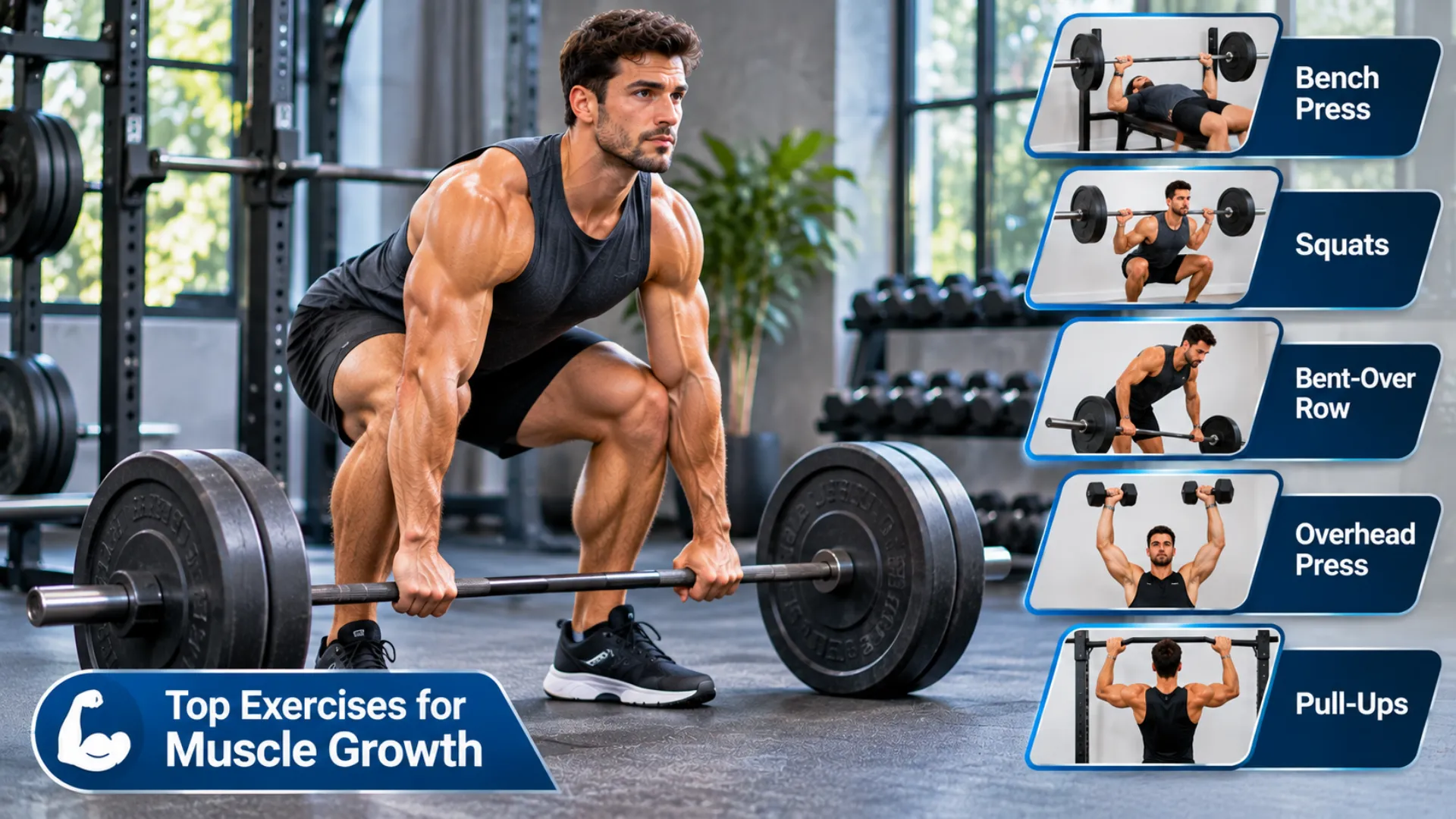
Even when you’re performing the right exercises, certain training habits can slow your progress.
Here are some mistakes to avoid:
1. Using too much weight
Lifting weights that are too heavy can compromise your exercise technique. Choose resistance that challenges you without forcing you to sacrifice proper form.
2. Ignoring smaller muscle groups
Focusing only on your chest, arms, or legs can lead to an unbalanced routine. Train all major muscle groups and include appropriate isolation exercises.
3. Changing exercises too frequently
You need enough time to improve your performance and measure progress. Stick with a structured program instead of constantly switching routines.
4. Not allowing enough recovery
Muscles need time to recover after challenging workouts. Avoid repeatedly training the same muscle groups intensely without adequate rest.
5. Not eating enough protein
Insufficient protein intake can make it harder to meet your muscle-building goals. Include protein-rich foods throughout the day.
6. Expecting results too quickly
Muscle growth takes time. Focus on consistent training and gradual improvements instead of expecting dramatic changes after a few workouts.
Some of the best exercises include squats, deadlifts, bench presses, pull-ups, rows, shoulder presses, lunges, and hip thrusts. These movements target major muscle groups and can be progressively adjusted to support muscle development.
There isn't one exercise that builds muscle faster than all others. Compound movements such as squats, deadlifts, bench presses, and rows are excellent choices because they train multiple muscle groups. Consistent training, sufficient nutrition, and recovery are also important.
Most people can build muscle by training two to four times per week. The best schedule depends on your experience, training volume, and recovery needs.
Both are useful. Compound exercises train multiple muscle groups at once, while isolation exercises allow you to give specific muscles additional attention. Combining them creates a more balanced workout routine.
Yes. Exercises such as push-ups, pull-ups, squats, lunges, and dips can stimulate muscle growth when they provide enough resistance and are progressively made more challenging.
Choosing the right exercises is an important step toward building a stronger and more muscular body. Movements such as squats, deadlifts, bench presses, rows, and shoulder presses provide a strong foundation for muscle development.
However, the best results come from combining effective exercises with progressive overload, balanced nutrition, and adequate recovery.
You don’t need to perform every exercise available or spend hours at the gym. Start with a manageable routine, focus on proper technique, and gradually challenge your muscles as your strength improves.
At Kirkland Personal Trainer, you can explore structured muscle-building and strength training programs designed to help you work toward your fitness goals.
Whether you’re new to resistance training or looking to overcome a muscle-building plateau, having a clear workout plan can help you train with more direction and consistency.
Explore our Muscle Building Programs in Kirkland and discover training options designed to help you develop muscle, improve strength, and work toward the physique you want.
Start with the right exercises, stay consistent, and give your body the time it needs to grow.